Men's Facial Exfoliation: How Often, Chemical Peel vs. Scrub, and How to Do It Right

Contents
Men's facial exfoliation is probably the most misunderstood part of men's skincare. For most Italian men, it means only one thing: the grainy scrub that scrapes under the shower, perhaps the "menthol" one that stings. But that's exactly the wrong idea. Exfoliating your face properly doesn't mean scrubbing harder: it means removing the layer of dead cells in the most intelligent and least violent way possible, with the right frequency and — this is the rule no one tells you — with sunscreen the day after. In this guide, we start from scratch: what exfoliation really is, how often men should exfoliate their faces, the difference between chemical peels and physical scrubs, and how to do it without damaging your skin. Men's treatment, laboratory science.
What exfoliating your face means (and why it's really necessary)
Let's start with the absolute basics. Your skin constantly renews itself. The outermost layer of the epidermis — the visible part of the skin — is called the stratum corneum and is made up of dead, flattened cells called corneocytes. These are "shield" cells: they protect you, then they detach and fall off, replaced by new cells that rise from below. This replacement is called cellular turnover.
In young adults, complete turnover takes about 28 days. The problem is that this rhythm slows down: with age, stress, smoking, urban pollution, and sun damage, the cycle lengthens significantly. When turnover slows down, dead cells accumulate on the surface instead of shedding. You see the result in the mirror: a dull and lackluster complexion (dead cells block and scatter light, the skin no longer "reflects"), pores that appear larger, more stubborn blackheads, and skin that absorbs anything you put on it less effectively.
Exfoliating simply means aiding that renewal: controlled removal of the layer of dead corneocytes that the skin, on its own, is shedding too slowly. Done correctly, it gives you a more even, luminous, and receptive surface.
Exfoliation doesn't "clean more deeply": it accelerates a natural process that time, stress, and pollution have slowed down. It's maintenance, not aggression.
Exfoliation is not cleansing: two different things
This is the number one misconception. Facial cleanser washes away sebum, sweat, and daily grime: you use it twice a day, morning and evening. Exfoliant, on the other hand, removes dead cells and is a targeted and periodic treatment, not a daily gesture. They are two distinct moments in the routine, with two different purposes. Confusing them — and treating a scrub as if it were soap to be used every day — is the first mistake that leads directly to irritated skin.
Chemical or physical exfoliation? The two families, explained
There are two opposing ways to remove dead cells. Understanding the difference is the central point of this entire guide, because shaving marketing has been selling you the wrong one for years.
1. Physical (mechanical) exfoliation: the scrub
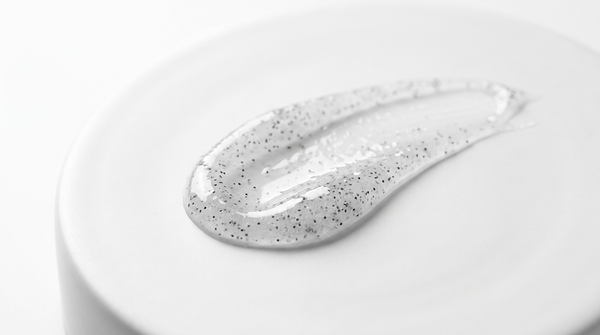
This is the one you already know: micro-granules, ground nutshells, brushes, rough gloves. The action is purely mechanical: you rub and the abrasion detaches dead cells. It works, it's true. The problem is how. The rough texture, especially if the granules are angular and you scrub forcefully, creates micro-lacerations — micro-cuts invisible to the naked eye on the stratum corneum. Every micro-cut is an open door: irritation, redness, possible bacterial colonization, and a clear worsening if you have reactive skin, fragile capillaries, or dermatitis. It's the classic case of the cure being worse than the disease.
2. Chemical exfoliation: acids (and they're not scary)
Here the word "acid" sounds scary, but it's just chemist terminology. Nothing burns the skin. Chemical exfoliants are molecules that, at low concentrations, gently dissolve the "glue" that holds dead cells together. This glue, technically, is made of desmosomes: the protein bridges that link one corneocyte to another. The acid loosens them and the dead cells detach on their own, evenly, without you having to rub anything. No friction, no micro-cuts.
Most dermatologists consider the chemical route, for the same result, to be gentler AND more effective than aggressive scrubbing. It's counterintuitive but true: low-percentage acid is gentler than abrasive granules.
A "chemist's detail": free form and pH
Without getting into numbers, it's worth knowing one thing that distinguishes a serious formula from a clever one. An exfoliating acid only truly works when a portion of its molecules are in "free" form (i.e., chemically active). Incorrect formulas either over-buffer the acid to make it "mild" for marketing claims, so it barely exfoliates; or, conversely, they leave it too raw, making it irritating. Good formulation balances the acid so it is effective but tolerable, combining it with ingredients that work in parallel. This is not a nerd detail: it's the difference between an exfoliant that works and one that irritates you or does nothing.
| Feature | Physical Scrub | Chemical Peel |
|---|---|---|
| How it works | Mechanical friction (scrubbing) | Dissolves bonds between dead cells |
| Risk of micro-tears | High (angular granules + pressure) | Absent |
| Uniformity | Irregular (where you scrub most) | Even across the entire face |
| Sensitive / reactive skin | Not recommended | Yes, by choosing the right acid |
| Works inside the pore? | No, only on the surface | Yes, if it's a BHA |
Myth to debunk: "chemical is aggressive, natural scrub is safe." It's often the opposite. Granules are mechanical and can injure; low-concentration acid works in a controlled and predictable manner.
AHA, BHA, PHA: what's the difference (and which one is for you)
Given that acids are the best way, they are not all the same. They are divided into three families, and the choice changes depending on your skin and your goal. This is the technical part that "men's" content never explains.
AHA — alpha-hydroxy acids (surface, texture, luminosity)
AHAs are water-soluble: they dissolve in water and therefore work on the surface, on the stratum corneum. They are the kings of smooth texture, luminosity, and even skin tone. The main ones:
- Glycolic acid: derived from sugarcane, it has the smallest molecule of all. Small means it penetrates efficiently and acts decisively — the true workhorse of surface exfoliation. We talked about it in detail in the in-depth article on glycolic acid for men.
- Mandelic acid: a larger and "slower" molecule, therefore better tolerated. An excellent compromise for those with reactive skin who still want an AHA.
- Lactic acid: an AHA that exfoliates and simultaneously retains some water, making it gentler.
BHA — beta-hydroxy acids (inside the pore, sebum, blackheads)
The quintessential BHA is salicylic acid. Its peculiarity is that it is lipid-soluble: it dissolves in fats, not water. This allows it to penetrate inside the pore, which is full of sebum (fat), and work there — dissolving excess trapped keratin and the sebum plug that generates blackheads and closed comedones (those bumps under the skin that don't come to the surface). This is why BHA is often cited as the "textbook" active for oily, combination, and acne-prone skin, which is the most common male skin profile: more testosterone means more active sebaceous glands, more visible pores, and more blackheads.
PHA — polyhydroxy acids (the most delicate)
PHAs (like gluconolactone) have the largest molecule of all: they penetrate very little, so they exfoliate very softly and also retain water (humectant effect). They are the choice for very reactive skin, where even a mild AHA would cause discomfort.
Quick mental rule: AHA = texture and luminosity on the surface. BHA = sebum and blackheads inside the pore. PHA = gentlest for skin that reacts to everything.
AHA or BHA for men's skin? Why glycolic (almost always) does the job
At this point, the novice thinks: "I have pores and blackheads, so I definitely need a BHA." It's the automatic reflex — but it's an oversimplification. In reality, on healthy but oily male skin, a well-formulated evening leave-on AHA does an excellent job on texture, pores, and blackheads, and here's why.
- Glycolic acid doesn't just stay "on top." Having the smallest molecule in its category, glycolic AHA exfoliates the stratum corneum deeply and evenly: fewer dead cells accumulated around the pore opening means fewer clogs forming, thus fewer blackheads over time. It addresses the root of the problem, not just the symptom.
- It doesn't work alone. What completes the picture is the combination with niacinamide, which helps regulate sebum and calm the skin, and with hyaluronic acid which rehydrates while the skin renews itself. It's the combination, not the single acid, that manages pores and texture.
- It's simpler to manage for a beginner. Building an entire routine around an evening AHA is more straightforward than layering different actives. For those starting from scratch, it's the path with the best result-to-risk ratio.
This is exactly the logic behind our PURIFY: a night exfoliant with 7% Glycolic Acid (AHA), Niacinamide, and medium molecular weight Hyaluronic Acid to rebalance and deeply hydrate while the skin renews itself. Fragrance-free, because newly renewed skin doesn't need anything that could sensitize it. In other words: it covers male skin's texture, pores, and blackheads with a single evening step, formulated to be effective but tolerable — not a raw acid just thrown into the formula.
Leave-on or rinse-off: why it matters more than you think
Another distinction that novices ignore. A chemical exfoliant can be:
- Rinse-off (wash-off): you apply it, it stays on for a few seconds, and you remove it. The acid has little time to work, so the effect is mild. Typical of exfoliating cleansers.
- Leave-on (do not rinse off): you apply it in the evening, leave it on your skin all night, and it works while you sleep. Here the active has hours to act, so the result is much more consistent.
For serious exfoliation, the evening leave-on format is what really makes a difference on texture and pores — and that's why PURIFY is designed for night use, not for a quick rinse in the shower.
How often to exfoliate your face (and why rhythm matters more than the product)
And here we are at the number one question: how often should a man exfoliate his face? The short answer is: not every day, never. The real answer requires understanding a concept, because without the mental model, you'll end up overdoing it.
The mental model: the barrier needs rest
Beneath the corneocytes you exfoliate is the skin barrier — the structure that retains water within the skin and keeps external aggressors out. It's made of lipids: ceramides, cholesterol, and fatty acids, arranged like mortar between bricks. When you exfoliate, you stress this barrier. An occasional challenge stimulates it to rebuild itself stronger. Continuous challenges, without breaks, only demolish it. This is why the 28-day turnover is key: the skin has its own biological rhythm, and exfoliation should support it, not force it every night.
"Skin cycling" and why the 10-day-a-month cycle
Most guides just give you a number — "1-2 times a week" — without explaining why. The underlying principle is called skin cycling: you alternate active phases with recovery phases, so the barrier always has time to reorganize before the next challenge. You get all the benefits of accelerated turnover, without saturating the skin.
This is exactly the logic with which we built PURIFY: it is used in the evening for 10 days a month, and for the remaining ~20 days, it gives way to the hydrating serum HYDRATE. Ten days of renewal, twenty of recovery and deep hydration. This isn't a random number: it's the rhythm that respects the skin's natural cycle and gives you results without the risk of over-exfoliation. If you want to see how this all fits into a real month and what to expect week by week, we've explained it in the article on 30 days of routine and results.
It's not "how many times a week," it's "how much recovery time I give the barrier between one phase and the next." 10 days of work, 20 days of rest: it's skin cycling, and that's why PURIFY is cyclical.
What if I use a physical scrub?
If you absolutely must use a mechanical exfoliant, maximum 1-2 times a week, with fine, rounded granules, and without pressing: let the product do the work, not your hand. But if you have to choose, for oily and comedogenic male skin, chemical leave-on is the smartest way.
Beard, shaving, and ingrown hairs: the male advantage
Here's why exfoliation, for men, is even more useful than for anyone else — and it's the point that "feminine" guides never touch upon.
Ingrown hairs occur when a regrowing hair, instead of exiting the follicle, gets trapped under a plug of dead cells and grows inwards, leading to those red, painful bumps after shaving (the so-called razor bumps or folliculitis barbae). Exfoliating clears the follicle opening of dead cells: the hair finds its way out straight, and the problem is drastically reduced. Additionally, on exfoliated and smooth skin, the razor glides better and the cut is cleaner.
- When to exfoliate relative to shaving? Not on the same day, and never immediately before shaving. Shaving is already a form of mechanical exfoliation: the blade removes a layer of cells. Adding a scrub or acid immediately before shaving means sensitizing the same skin twice. It's better to exfoliate in the evening, on a day when you don't shave, and shave on rested skin.
- Irritated skin after shaving? Wait for it to calm down before exfoliating. If redness and irritation after shaving are frequent, the problem is often an already compromised barrier: also see how ceramides protect the barrier during shaving and the in-depth article on beard, face, and protection.
The non-negotiable golden rule: SPF the day after
If you remember only one thing from this entire guide, remember this. AHAs are photosensitizing. That's not a figure of speech: in an FDA study, applying 10% glycolic acid every day for three and a half weeks was enough for the same dose of sun to cause more redness and more DNA damage than on untreated skin. In other words, while you're using acids your skin handles UV rays worse than usual — and the effect isn't permanent: once you stop, it goes back to normal in about a week.
Exfoliating with acids and then not applying sunscreen the next day is counterproductive: you accelerate turnover but expose new skin to UV damage, and the net result is worse than before — increased risk of dark spots, more photoaging (aging caused by the sun, not age). In practice: you ruin the work you just did.
This is why SPF is not a bonus tip: it is part of the exfoliating treatment. It should be used always, not just in summer (the UVA rays that age the skin pass through even on cloudy days and in the city). It's the role of the last step of your morning routine: PROTECT+, the SPF 50+ day cream, light texture, the only vegan in the line and reef-friendly. In summer, attention doubles: we talk about it in SPF, beard and summer and in antioxidants against urban stress.
If you exfoliate, wear SPF the next day. Period. There is no version of this sentence where SPF is optional.
Olive or dark skin? An extra precaution
There's an additional, and rarely mentioned, reason why individuals with darker skin (high phototypes, olive or intense Mediterranean complexions) need to exfoliate carefully. On these skin types, even minor inflammation — an aggressive scrub, an overly strong acid, or sunburn on freshly exfoliated skin — can leave a residual dark spot, known as post-inflammatory hyperpigmentation. In other words, overdoing it not only doesn't help but risks leaving a mark precisely where you aimed to even out your skin tone. The correct strategy is the opposite of aggression: gentle, consistent, cyclical exfoliation, and diligent SPF use. Niacinamide, in parallel, also works on evening out skin tone.
Over-exfoliation: who should be careful and how to tell if you've overdone it
The number one risk for beginners is getting enthusiastic and doing too much. "If a little is good, more must be better": false, and with exfoliation, it's the quickest way to worsen your skin. Exfoliating too often, too aggressively, or layering multiple different acids (stacking) damages the skin's lipid barrier. Signs of over-exfoliation:
- Persistent redness, a feeling of "tight" skin;
- Burning or stinging even when just applying water or moisturizer;
- Flaking, small pieces of peeling skin;
- Skin that "shines" strangely and reacts to any product;
- Paradoxically, more breakouts and oiliness, because the damaged barrier goes haywire.
If you recognize these signs: stop all active ingredients, return to a gentle cleanser + hydrating serum + moisturizer for one to two weeks, and let your barrier recover. Then resume with reduced frequency.
Myth to debunk: "if it stings, it means it's working." No. A slight initial tingling can be normal, but persistent burning is an alarm bell, not proof of efficacy. Good exfoliation is barely felt.
Who should NOT exfoliate too much (the honesty that defines us)
Exfoliation is not for everyone in the same way. Be very cautious, or avoid strong acids, if you have:
- Couperose (visible dilated capillaries on the cheeks and nose, indicating vascular fragility) or rosacea (a chronic inflammatory condition with recurrent redness, which is different and should be managed by a doctor): in both cases, scrubbing is practically forbidden; only very gentle PHAs might be an option, and with caution.
- Atopic dermatitis or very sensitive skin: already a fragile barrier, exfoliation further stresses it.
- An already compromised barrier (perhaps from previous over-exfoliation): first rebuild it, then consider exfoliating.
In these cases, a dermatologist is the right person to consult. We prefer to tell you this than sell you a product that will worsen your skin.
And retinoids? A note for those going further
If you've already heard of retinol or retinoids: they also accelerate cell turnover, but through a different mechanism than acids. The golden rule for a beginner is not to layer them with a chemical exfoliant on the same evening: two accelerators together, on unaccustomed skin, are the perfect recipe for over-exfoliation. One thing at a time, and your barrier will thank you.
How to incorporate exfoliation into your routine
Correct order: leave-on exfoliant goes after cleansing (on clean, dry skin) and before richer creams. Here's how it fits into an HBSKN routine, where exfoliation happens in the evening, in cycles:
- Morning (AM): CLEANSE → HYDRATE → PROTECT+ (protection always concludes the morning routine).
- Evening (PM), "normal" days: CLEANSE → HYDRATE → ANTI-AGE+.
- Evening (PM), during the 10-day cycle: CLEANSE → PURIFY instead of your evening treatment. For the other ~20 days, return to HYDRATE.
And after exfoliation, always moisturize: freshly renewed skin "drinks" much better. To navigate between cleanser, serum, and cream, the article moisturizing cream or serum clarifies their roles, while men's skincare: where to start and which kit to choose help you start without mistakes.
How long to see results
Exfoliation is not a one-off cure before an event: it is ongoing management. For blackheads and skin texture, you may notice an initial change within 1-2 cycles (i.e., a few weeks of correct use, not days). But the real leap — less noticeable pores, more even skin — comes with consistent use over time. And remember two honest truths: pores never truly "close" (that's a myth); by clearing them and regulating sebum, PURIFY visibly reduces pores, making them simply less evident. Similarly, exfoliation reduces and prevents blackheads and comedones, but does not eliminate them forever: they need continuous management.
In summary: exfoliation done the way a chemist would do it
Forget the gritty scrub in the shower. Proper men's facial exfoliation is chemical, gentle, cyclical, and always accompanied by sunscreen. To recap:
- Exfoliating = accelerating turnover, not scrubbing harder;
- Chemical > physical: low-percentage acid is safer than granules that cause micro-tears;
- AHAs (glycolic) for men's skin texture, radiance, pores, and blackheads; BHAs (salicylic) as a targeted alternative for oiliness; PHAs for more reactive skin;
- Not every day: the barrier needs recovery — this is the logic of PURIFY's 10-day/month cycle;
- Exfoliation helps against ingrown hairs and razor bumps, a distinct male advantage;
- The next day, SPF: non-negotiable.
If you're starting from scratch and the idea of building a routine seems daunting, the smartest way to begin risk-free is with the ESCAPE KIT: you experience clean and protected skin with zero risk, and the €39 becomes credit towards a complete routine. When you want to incorporate cyclical exfoliation into your month, PURIFY is part of the Purification Routine (CLEANSE + HYDRATE + PURIFY + PROTECT+), or the Complete Routine if you want everything, morning and evening. Thirty days satisfaction guaranteed or your money back: skin, like anything well-engineered, rewards consistency.
Frequently Asked Questions
Never every day. With a leave-on chemical exfoliant used in the evening, the intelligent frequency is cyclical: 10 days a month (skin cycling), alternated with ~20 days of hydration and recovery, so the skin barrier always has time to reorganize. This is precisely the rhythm PURIFY is designed for. If you use a physical scrub, no more than 1-2 times a week and without pressing hard. Exfoliating every day is the fastest way to damage your skin.
For most men, a low-concentration acid. A scrub works by friction and, if the granules are sharp or you rub too hard, it creates invisible micro-tears that irritate. A chemical exfoliant dissolves the bonds (desmosomes) between dead cells and removes them uniformly, without scrubbing. For the same result, it's gentler and more predictable. Aggressive scrubbing is especially not recommended for reactive skin, or skin with couperose or fragile capillaries.
No. BHA is an excellent molecule specifically targeted at sebum inside the pore, but it's not the only way. A well-formulated leave-on glycolic AHA used in the evening, combined with niacinamide (which helps regulate sebum) and hyaluronic acid, effectively manages texture, pores, and blackheads in men's skin by acting on the formation of plugs. This is the logic of PURIFY (7% Glycolic Acid + Niacinamide + Hyaluronic Acid): a single evening step, simpler to manage for beginners.
Leave-on exfoliant goes after cleansing, on clean and dry skin, and before richer creams. In the HBSKN routine, during the 10-day cycle, in the evening you cleanse → PURIFY (instead of your evening treatment) and then rehydrate. For the other ~20 days, you return to cleanse → HYDRATE → ANTI-AGE+. The rule is: exfoliate on clean skin, and always moisturize afterward, because freshly renewed skin absorbs much better.
Yes, always. AHAs like glycolic acid are photosensitizing: they thin the stratum corneum and leave newer, more vulnerable skin exposed to the sun, even the day after an evening application. Exfoliating without then protecting from the sun is counterproductive: it increases the risk of dark spots and photoaging. SPF is part of the treatment, not an extra. This is the role of PROTECT+ (SPF 50+), the last step in the morning, all year round and not just in summer.
Yes, and it's actually particularly useful. Exfoliating clears the hair follicle opening of dead cells and reduces ingrown hairs and razor bumps. The rule is not to exfoliate on the same day you shave (the blade is already a mechanical exfoliation): it's better to do it in the evening, on a day without shaving. For skin with a thick beard, apply the exfoliant by massaging it well into the skin at the base of the hair, not just on the surface. If your skin is irritated from shaving, wait for it to calm down before exfoliating.
No, and that's intentional. PURIFY is a cyclical nighttime exfoliant: it's used in the evening for 10 days a month, then for the remaining ~20 days it gives way to the HYDRATE hydrating serum. This rhythm (skin cycling) provides all the benefits of accelerated turnover while avoiding over-exfoliation, which is characterized by persistent redness, tight skin, burning, and, paradoxically, more oil and breakouts. Using it every day does not accelerate results: it damages the barrier and worsens them.
Sources
The scientific claims in this article are backed by peer-reviewed research. Below are the primary sources, available in full.
- The effects of topically applied glycolic acid and salicylic acid on ultraviolet radiation-induced erythema, DNA damage and sunburn cell formation in human skin. Journal of Dermatological Science, 2009.
- Effects of glycolic acid on desquamation-regulating proteinases in human stratum corneum. Experimental Dermatology, 2005.
Products in the article